English
 Français
 Deutsch
 Español
 عربي
عربي
In precision manufacturing, even a slight deviation in perforation accuracy can lead to costly material waste and production downtime. Many production engineers and machine operators face a recurring issue — instead of creating clean, consistent perforations, their materials are tearing. The cause often lies not in the base material or machine speed, but in the perforation needle roller itself.
Perforation needle rollers are vital in applications such as film converting, paper processing, nonwoven production, packaging, and lamination. Choosing the correct type can mean the difference between a smooth-running line and a continuous headache of rejected batches.
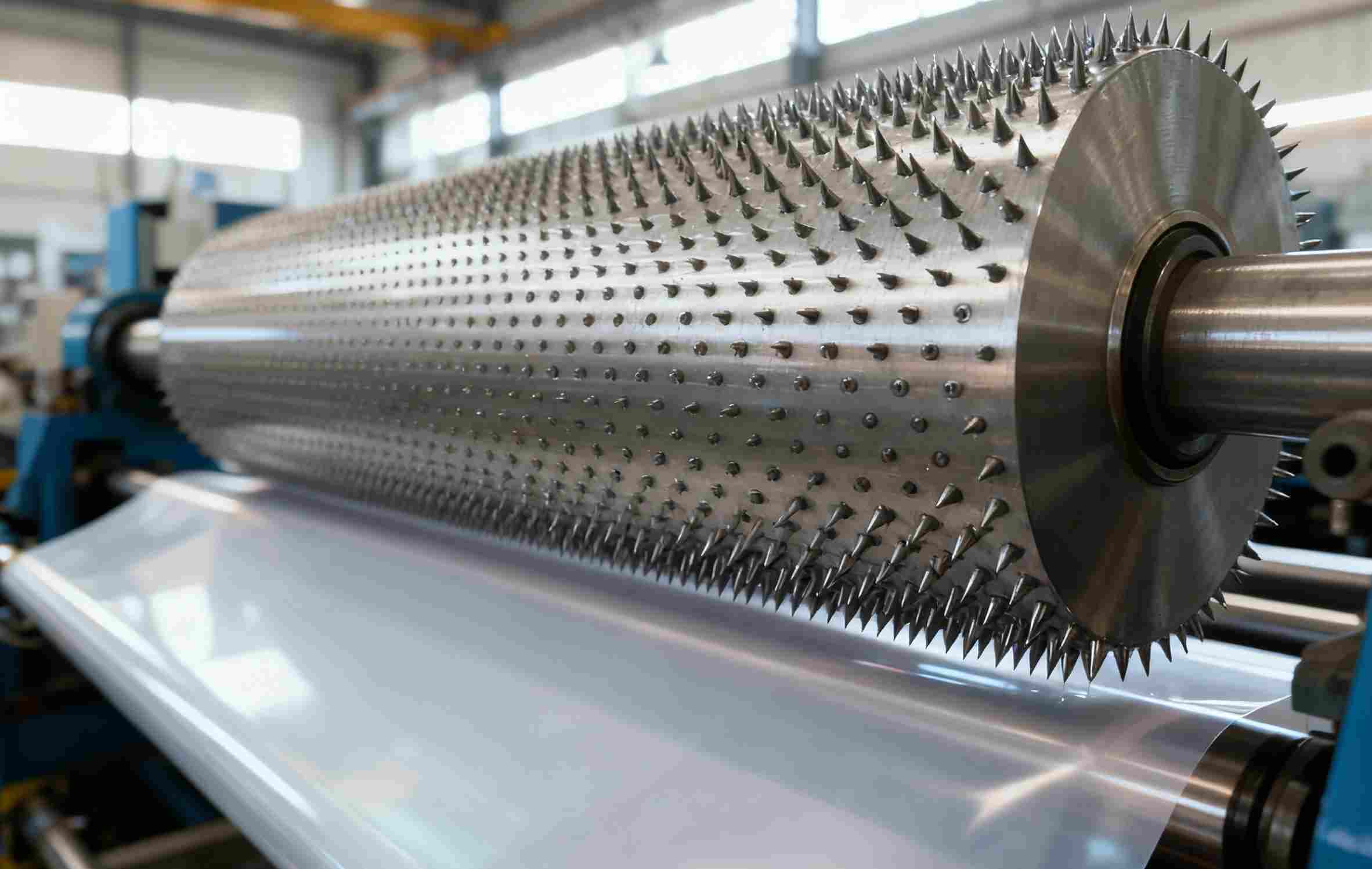
Perforation is a controlled process of creating micro or macro holes to achieve specific airflow, tearing strength, or release characteristics. In packaging and hygiene product industries, uniform perforation ensures the right balance between strength and usability.
However, when operators use an unsuitable Industrial Perforation Needle Roller, the perforation turns into micro-tearing — a problem that increases production scrap by up to 12–18%, according to 2024 data from APC Converting Equipment Survey. This directly affects:
| Performance Factor | Ideal Perforation Roller | Worn / Incorrect Roller |
| Hole Uniformity | ±0.01 mm deviation | ±0.15 mm deviation |
| Material Tension | Stable, evenly distributed | Uneven, causes edge tearing |
| Heat Resistance | 250–350°C | <200°C, leads to needle expansion |
| Production Yield | 96–98% | 80–85% |
When the roller’s precision is off, tension along the material web becomes uneven, resulting in ragged perforations or tearing edges. Over time, this misalignment not only degrades product quality but also increases the stress load on downstream rollers and cutting blades.
To understand how to fix tearing, it’s important to look at the mechanical and material-level causes.
Based on over 500 industrial case studies, the top five factors are:
Incorrect needle angle or density – If the needle pitch or diameter doesn’t match the film or paper GSM (grams per square meter), the perforation creates stress instead of cuts.
Low-grade needle material – Rollers made from low-hardness steel (
Improper heat treatment – Uneven hardening across the roller body causes deformation during high-speed runs.
Roller imbalance – When a Custom Perforation Needle Roller for plastic film lacks dynamic balancing, vibration at speeds above 200 m/min can lead to tearing instead of piercing.
Contamination or coating wear – Accumulated adhesive residue increases friction, changing the perforation line geometry.
The right high precision perforation needle roller for packaging film is engineered to handle both speed and material consistency. The selection depends on several parameters:
| Material Type | Recommended Needle Tip | Roller Hardness (HRC) | Speed Capability (m/min) | Surface Coating |
| LDPE / HDPE Film | 30° Cone, Ø0.5 mm | 55–58 | 300–350 | Chromium or TiN |
| Nonwoven Fabric | 25° Needle, Ø0.4 mm | 50–54 | 250–300 | Nickel |
| Paper (60–120 GSM) | 35° Needle, Ø0.6 mm | 60–62 | 200–250 | Chrome-plated |
| Aluminum Foil | 40° Needle, Ø0.3 mm | 58–60 | 150–180 | Diamond-like Coating (DLC) |
Choosing a roller built from 42CrMo steel with precision-ground surfaces ensures higher dimensional stability under high thermal loads. Moreover, the use of CNC-milled needle plates allows for accuracy up to ±5 microns, dramatically reducing tear initiation points.
Recent analysis from Global Web Processing Machinery Association (2024) highlights that production lines equipped with High Performance Perforation Needle Roller Assemblies showed measurable gains:
| Metric | Before Optimization | After Optimization |
| Material Waste | 11.3% | 3.6% |
| Line Downtime | 7.5 hrs/week | 2.1 hrs/week |
| Energy Efficiency | 88% | 95% |
This data underscores that the roller’s geometry and material composition directly influence the perforation’s microstructure, which can be visualized using SEM imaging. Uniform puncture depth and edge smoothness translate to smoother product winding and more predictable tension control.
Even the most advanced precision perforation needle roller for film converting will degrade without proper maintenance. Here’s what experts recommend:
Clean regularly using ultrasonic baths to remove adhesive or ink residue.
Inspect wear patterns every 200 production hours using optical measurement.
Recoat or polish every 6 months to maintain surface hardness above HRC 58.
Balance testing after every major production cycle (>10 million revolutions).
Neglecting these steps can cause micro-vibrations that affect perforation uniformity by up to 20%.
The industry is rapidly adopting smart perforation rollers equipped with sensors that monitor heat buildup and mechanical stress in real time. By integrating these rollers with digital process monitoring, manufacturers can automatically adjust web tension and roller speed. This ensures stable operation across varying humidity, material thickness, and temperature conditions.
As the market for high-speed converting continues to grow—expected to exceed USD 2.4 billion by 2026—choosing the correct perforation needle roller is no longer optional; it’s a key competitive advantage.
You can contact us for help in any of the following ways


Copyright © 2026 Anqing Hongyue Machinery Equipment Co., Ltd. All Rights Reserved.
 Network Supported